What Market Sentiment Actually Measures
A single number for the mood of the market sounds like a buy button. It is closer to a barometer. Knowing the difference is the whole skill.
What does a market sentiment gauge actually measure?
A sentiment gauge condenses the mood of a market into one number on a dial, fear at one end, greed at the other. It is a genuinely useful instrument, and it is almost always misread the same way: as an instruction. A high reading feels like "buy," a low one like "sell," and the whole appeal of a single needle is that it seems to save you the thinking.
It does not. A barometer that reads "stormy" is not telling you to cancel the trip; it is telling you what the air is doing right now, so you can decide with better information. Sentiment is the same. It measures the weather in the market, the balance of fear and greed priced into how people are behaving, and it measures it well. What it cannot do is tell you what happens next, because the weather is not the forecast.
This piece is about that gap: what a sentiment reading actually contains, and what it structurally cannot. Get the two straight and the gauge becomes what it should be, a piece of context you weigh, rather than a signal you obey.
What goes into a sentiment reading?
A serious sentiment measure is a composite. No single input captures mood, so several are blended, each one a different fingerprint of the same emotion.
Price behaviour is the loudest. How far the market has run above or below its own trend, how much of the recent move is momentum, whether strength is broad or carried by a handful of names, all of it encodes how eager or fearful buyers have been.
Volatility is the market's pulse rate. Calm, low-volatility conditions read as complacency; sharp spikes read as fear. The size of the swings says as much about mood as the direction.
Breadth asks how many boats are actually rising. A market climbing on a wide base of advancing stocks is a different mood from one dragged up by five giants while everything else sags, even if the headline index looks identical.
Positioning and flow, where available, show what people are doing with money rather than what they are saying, which is usually the more honest signal.
Blend these and you get a number that describes, with real fidelity, how much fear or greed is currently in the tape. That description is the product. It is accurate, and it is present tense.
Can market sentiment predict the market?
Here is the load-bearing sentence: sentiment measures the present, and the present is not a prediction.
A reading of extreme greed tells you the mood is euphoric. It does not tell you whether euphoria breaks tomorrow or runs for another six months, and euphoria has done both. A reading of extreme fear tells you the mood is grim, which is often where bottoms form and just as often the middle of a decline that has further to go. The gauge is honest about now; it is silent about next, and no amount of staring at the needle converts one into the other.
There is a second, subtler limit: sentiment is reflexive. Because so many people watch it, extreme readings can change behaviour, which changes the reading. That does not make it useless, but it does mean it is not a fixed law of nature. It is a crowd measuring itself, and crowds move.
None of this is a flaw to be engineered away. It is what the instrument is. A thermometer that tried to tell you tomorrow's temperature would be a worse thermometer, not a better one.
How should you use a sentiment reading?
If sentiment is context rather than command, ask it what it changes about how you read everything else, rather than what it tells you to do.
As a tilt on conviction, not a trigger. When your own work on a stock or a market lines up with the mood, that is confirmation worth noting. When it cuts against the mood, that is not a veto, it is a prompt to check your assumptions harder. The gauge adjusts the weight you give your own analysis; it does not replace it.
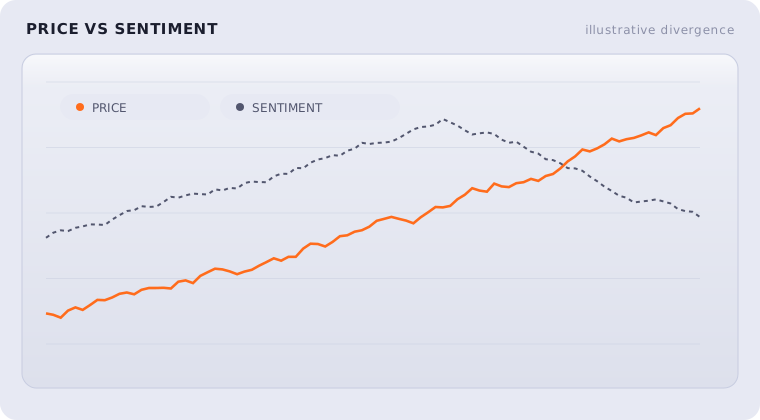
As a divergence detector. The most interesting moments are when mood and price disagree, a market grinding higher while sentiment quietly rolls over, or falling while fear stops deepening. A divergence is not a signal to act. It is a good question: why are these two apart, and which one is early.
As a discipline against yourself. Sentiment's most honest use is as a mirror. Extreme greed is the moment to reread your riskiest position; extreme fear is the moment to check whether you are selling the plan or selling the fear. The gauge is often most valuable pointed inward.
What it should never be is the whole decision. A number for the mood of a market is a powerful piece of context and a terrible master.
Where does the sentiment reading leave you?
The gauge earns its place by compressing a lot of market behaviour into one honest, present-tense number. That is real, and it is enough to be worth watching daily. It is also the beginning of a decision, not the end of one.
Read it as weather. It tells you what the market is doing right now, which is genuinely useful for deciding what to carry and how much to trust the next move. It does not tell you what tomorrow holds, and the moment it starts to feel like it does is the moment it has quietly stopped being a barometer and started being a bet.
Market sentiment is a description of current conditions, not a forecast or a signal to buy or sell. Illustrative figures are for demonstration.