Following the Smart Money, Without Getting Lost
Politicians and insiders have to disclose their trades. Reading those filings is easy. Reading them correctly is where almost everyone goes wrong.
What do congressional and insider disclosures actually show?
Two groups of people are required by law to tell you when they trade. Members of the US Congress disclose their transactions under the STOCK Act. Corporate insiders, the executives and directors and large holders of a company, disclose theirs to the regulator within days. The raw feed is genuinely public, and the appeal is obvious: these are people who might, plausibly, know something you do not.
The mistake is thinking the hard part is getting the data. It is not. The hard part is that a disclosed trade is a fact wrapped in a dozen possible motives, and the filing tells you the fact but almost none of the motive. A senator sold a stock: to dodge bad news, to pay a tax bill, to rebalance a blind trust, or because a staffer runs the account and they never saw it. An executive bought shares: because the business is turning, or because the board told them to hold more, or to send exactly the signal you are now reading. The number is clean. The meaning is not in the filing.
So this is not a piece about where to find the trades. It is about how to read them without fooling yourself, because the tracker is only as good as the interpretation you bring to it.
Why does an insider buy mean more than a sell?
The first correction is the most useful: a buy and a sell carry very different amounts of information, and treating them as mirror images is where most people go wrong.
There is an old line, usually attributed to Peter Lynch, that insiders sell for many reasons but they buy for only one. It overstates the case, but the core is right. People sell shares for endless reasons that have nothing to do with the company: a house, a divorce, a tax bill, a diversification rule, a portfolio manager they never speak to. A sale is noisy. It is consistent with the insider being bearish and equally consistent with them simply needing the money.
A purchase is cleaner. When someone who already has heavy exposure to a company, and knows it better than any outsider, chooses to put more of their own cash into it, the range of innocent explanations narrows. It is not proof of anything, but it is a less ambiguous act. This is why serious readers weight open-market buys far more heavily than sells, and why a wall of red is usually less meaningful than a single deliberate green.
Why do clustered trades matter more than single ones?
The second correction is about counting. One trade is an anecdote. Several, from different people, in a short window, is closer to a pattern.
A single insider buying could be one person's hunch, or one person's liquidity. But when several insiders at the same company buy around the same time, independently, the "they just needed cash" explanations stop lining up. Coordinated selling can be dismissed as a scheduled event; coordinated buying is harder to wave away, because there is no ordinary personal reason for five different people to independently want more of the same stock in the same month.
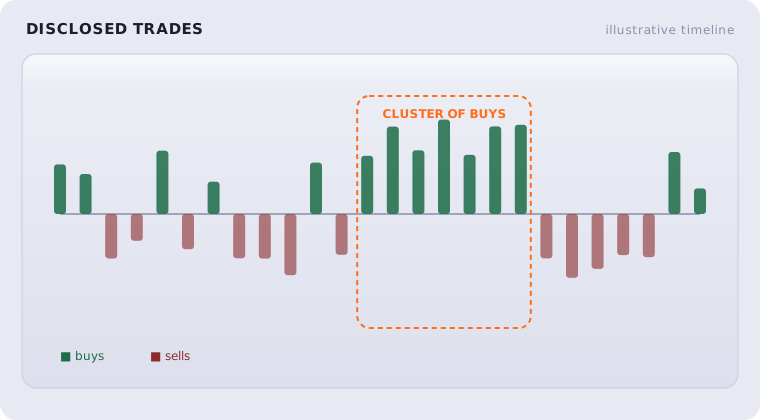
The same logic scales up to committees and sectors. When disclosures concentrate in an industry, or among the people who happen to oversee it, that concentration is more interesting than any one name. Not because it is a tip, but because clustering is the one thing individual noise cannot easily fake.
Can you just copy congressional trades?
Now the warning, because the failure mode here is specific and expensive: you cannot simply copy these trades, and the disclosure system is built in a way that makes copying worse than it looks.
You are always late. Disclosure comes with a lag, days for insiders, up to weeks for members of Congress. By the time you read the filing, the price has usually already moved on whatever the trader knew or guessed. You are copying an entry at a worse price, sometimes a much worse one.
You see the trade, not the thesis. A disclosure is a single frame from a film. You do not see the position it sits inside, the hedge on the other side, the time horizon, or the size relative to the person's wealth. A senator putting 1% of a fortune into a stock is a shrug; you copying it with 20% of yours is a different act entirely.
Survivorship and selection flatter the story. The winning copied trades get written about; the losing ones vanish. A strategy of blindly mirroring disclosures has a much less flattering record than the highlight reel suggests.
Used as a copy-trading engine, the tracker will mostly get you into good stories at bad prices. That is the opposite of an edge.
How should you use disclosure data?
So what is it good for? Used correctly, disclosure data is one of the better sources of the thing that is hardest to find: a reason to look.
As a lead generator, not a signal. The right output of a cluster of insider buys is not a trade, it is a name on your research list. The disclosure tells you where to point your own work, not what to conclude.
As a check on a thesis you already have. If you have done the analysis and reached a view, insider behaviour is a useful second opinion. Insiders quietly buying into your bullish thesis is corroboration; insiders selling into it is a reason to stress-test your assumptions.
As a map of attention. Watching where disclosures concentrate, which sectors, which committees, which companies, tells you where the informed are spending their own attention and money. That map is valuable even when no single trade on it is.
The tracker's job is to shorten the distance between "the informed are doing something" and "I should look at this." It is a spotlight, not an autopilot.
What is the Congress tracker actually for?
Disclosed trades are one of the few windows into what better-informed people are actually doing with their money, and that makes them worth watching every week. They are also lagged, ambiguous, and easy to over-read, which makes them dangerous to obey.
Hold both ideas at once. Weight buys above sells and clusters above any individual trade, then treat the whole thing as a reason to open the annual report rather than a replacement for reading it. A disclosure tells you where somebody put their money. It never tells you why, and the why is the part that decides whether they were right.