Fallen Angels That Still Gush Cash
A stock down 30% is either a bargain or a warning. One cash-flow filter tells you which, before you read a single annual report.
Is a stock down 30% cheap or broken?
A stock that has fallen 30% is telling you one of two things, and it will not say which. Either the market has overreacted and the price is now wrong in your favour, or the market has seen something real and the price is on its way to being right. Both look identical on a screen: a good business and a broken one wear the same red number.
This is the trap in bargain hunting. The discount is the hook, but the discount is also the danger. A falling price lowers every valuation ratio at once, so the cheapest-looking names in any market are disproportionately the ones with something wrong. Buy the drop without a second test and you are not being contrarian, you are being sorted into the losers.
The TradeIntel screener lets you stack filters, so this recipe answers the "which is it" question with two screens that fail in opposite directions. Fallen Angels finds the drop. Cash Cows checks whether the business underneath is still alive. A name that clears both is a rarer thing than either list alone: a company the market has marked down while it keeps generating real cash.
Filter one: what is a fallen angel?
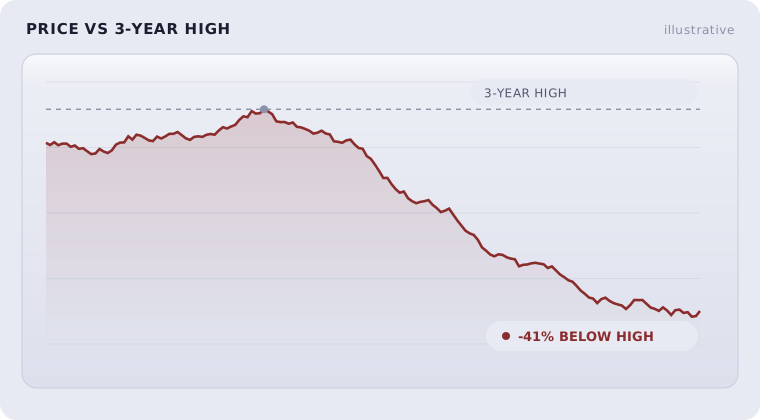
What it requires: a still-profitable company trading at least 30% below its three-year high, at a price-to-earnings ratio below the screened universe's median.
The idea is old and well-documented. De Bondt and Thaler's 1985 paper Does the Stock Market Overreact? showed that the stocks beaten down hardest over a three-to-five-year window tended to outperform the prior winners over the years that followed. Markets overshoot on bad news the same way they overshoot on good news; the reversal is the edge. The hard part has never been finding losers, it is separating a temporary punishment from a permanent decline.
So this filter refuses to screen on the fall alone. The 30% drawdown is measured from the highest close in the last three years, but two extra conditions come with it. The company must still be profitable, which throws out the outright failures. And it must still be cheap relative to its peers, not merely down, so a stock that fell from absurd to merely expensive does not qualify. A deeper drawdown scores higher, on the logic that a larger overreaction leaves more room to snap back.
But the filter has a blind spot it cannot fix from the inside. "Still profitable" is an income-statement test, and the income statement is where a struggling company looks healthiest for longest. Accruals, one-off gains, and generous timing can keep reported earnings positive while the actual cash drains away. A falling knife can show a profit right up until the moment it cannot. That is the exact failure this recipe's second filter exists to catch.
Filter two: what does the Cash Cows filter require?
What it requires: a free cash flow yield of 8% or more, with positive free cash flow in each of the last three years.
Free cash flow is what is left after the business has paid for everything it needs to keep running and growing. It is the cash that is actually there, as opposed to the profit that is merely reported. Dividing it by the company's market value gives a yield, and an 8% floor is a demanding one: the business must throw off real cash equal to at least 8% of its price, every year. The three-consecutive-years condition stops one flattering year, an asset sale or a cyclical peak, from sneaking a weak business onto the list.
The reason to trust cash over earnings is the reason this whole recipe works: cash is harder to fake. The academic quality literature keeps landing on the same finding. Novy-Marx's 2013 work on gross profitability, and Asness, Frazzini and Pedersen's Quality Minus Junk, both show that measures of real cash generation describe future returns better than reported earnings alone. A cheap price is only a bargain if the thing you are buying still produces something. Cash flow is the proof that it does.
Why do these two filters disagree?
The point of stacking is that the filters catch opposite lies.
Fallen Angels can be fooled by a company that is cheap because it is dying: the price is down for a reason the screen cannot see. Cash Cows catches exactly that, because a dying business stops generating cash long before it stops reporting profits.
Cash Cows, run alone, can be fooled the other way. A business can gush cash for a year or two at a cyclical peak, or after cutting every ounce of investment, and look like a cash machine right before the cash dries up. Fallen Angels does nothing to fix that on its own, but a name that is also down 30% and cheap is not sitting at a euphoric peak. The market's pessimism, which is the risk in the Cash Cows list, is the entry condition in the Fallen Angels list.
Neither filter trusts the other's strong suit. That is what makes the overlap worth more than the sum of the two lists.
How do you build this screen?
The recipe takes under a minute.
Step one. Open the stock screener and choose your market. Both filters run on the JSE and US universes, with the drawdown and valuation thresholds calibrated per market.
Step two. Switch on Fallen Angels. The list collapses to profitable names down at least 30% and cheap versus their peers.
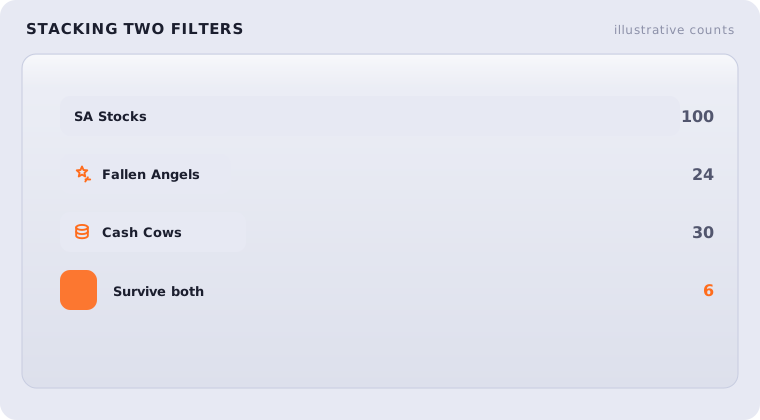
Step three. Switch on Cash Cows. Most of the fallen names drop away, because most things that have fallen 30% are not still generating 8% cash yields. What remains has passed the discount test and the survival test at once.
Each survivor carries a strength score on both filters, so the list ranks itself. A name down 45% throwing off a 12% cash yield sits above one down 31% scraping the 8% floor. The table below shows the shape of the output. It is illustrative, not a recommendation.
| Name | Below 3-yr high | FCF yield | Read |
|---|---|---|---|
| Example A | -44% | 12.4% | Deep discount, cash intact |
| Example B | -33% | 9.1% | Cheap, comfortably funded |
| Example C | -31% | 8.2% | Scrapes both floors, watch |
How should you read the results?
The screen ends where the work begins. A name that clears both bars with room to spare is a genuinely different proposition from one that scrapes past each, even though the screener shows a tick either way. The drawdown score tells you how much pessimism is priced in; the cash yield tells you whether the business can outlast it. Read them together.
The thresholds themselves, the 30% drawdown and the 8% cash floor, are set deliberately and are not knobs to fiddle with mid-screen. They are calibrated to be demanding without being empty, and they are the same for every user, so a name that clears them is clearing a real bar rather than one you loosened to fit the answer you wanted.
Where does this screen mislead?
Stacking two filters shrinks the blind spot. It does not remove it.
Both look backward. A three-year drawdown and three years of cash flow describe the company that was. A structural break, a new competitor or a regulatory shift, resets the story, and no historical screen sees it in advance. The discount may be pricing exactly that.
Cash flow is lumpy. A company in a heavy investment year can show weak cash flow while building real value, so the Cash Cows filter can drop good businesses in their spending years. Starve a business of investment and the reverse happens: cash flow flatters for a while before the underinvestment bites.
Some drops are correct. The profitability and valuation conditions filter out the worst, but no screen can tell a bargain from a falling knife with certainty. A stock down 30% because its main product is being regulated out of existence can still, for a while, be profitable and cash-generative on the way down.
The overlap is a shortlist that has earned a closer look. Whether the fall was deserved is a question the annual report answers and the screen cannot.