Cheap, and the Tape Just Turned
Deep value tells you a stock is worth more than its price. It never tells you when the market will agree. A trend filter answers the question value cannot.
Why do cheap stocks stay cheap?
The oldest complaint about value investing is not that it is wrong. It is that it is early. Buy a stock because it is cheap and you may be right about the worth and still wrong about the wait, sitting in a name that stays cheap, or gets cheaper, for years while the thesis quietly ages. "The market can stay irrational longer than you can stay solvent" is a joke about exactly this. Value tells you a price is wrong. It is silent on when the market will fix it.
That silence is the gap this recipe fills. The TradeIntel screener lets you stack filters, so this one pairs a pure valuation screen with a pure trend screen. Deep Value finds the mispricing. Golden Cross waits for the first sign the market has started to agree. One filter reads the accounts; the other reads the tape. Neither is enough alone, and that is the point.
Filter one: what does Deep Value screen for?
What it requires: a company trading cheaply on valuation, calibrated per market so "cheap" means cheap relative to the universe it trades in, not an absolute number.
Value is the most studied effect in finance. Fama and French built an entire factor around it; decades of data across countries and eras show that cheap portfolios have, on average and over long horizons, outrun expensive ones. The mechanism is not magic. A low price relative to earnings or assets is often the market pricing in bad news, and on average it prices in a little too much. The reversion of that excess pessimism is the value premium.
Calibration matters here more than anywhere. The US large-cap universe trades at a far higher median valuation than the JSE, so a "cheap" cutoff that catches a quarter of JSE names would catch almost nothing in the US. Deep Value defines cheapness against the current market it is pointed at, which is why the same filter surfaces genuinely different companies on the JSE than it does on the S&P.
But a value filter is a statement about worth, not about timing. It will hand you a stock that is cheap today and just as happily hand you the same stock, still cheap, a year from now. Cheapness is a necessary condition for a bargain and a completely insufficient one for a trade. Something has to tell you the wait is ending.
Filter two: what is a golden cross?
What it requires: the 50-day moving average rising up through the 200-day moving average, with price above both.
A moving-average crossover is the plainest trend signal there is. The 50-day average is the recent mood; the 200-day is the long memory. When the fast line climbs through the slow one, the recent trend has turned more positive than the long one, and by convention that shift is called a golden cross. It is not a forecast. It is a description: the tide, as far as price is concerned, has started to come in.
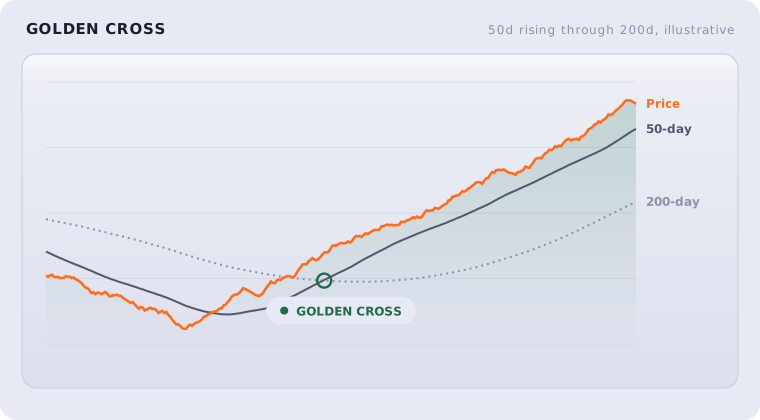
On its own, a golden cross is a weak signal, and honest about it. Trends whip back and forth, crosses fail, and a signal that every chart-watcher can see is not, by itself, an edge. Used alone it will chase momentum into expensive names and get shaken out. Its job in this recipe is narrow. It times the value list rather than picking the winners on it, and it answers the one question Deep Value cannot: has the market started to move yet.
How do you build this screen?
Step one. Open the stock screener and pick your market. Deep Value's cheapness cutoff is calibrated to whichever universe you choose.
Step two. Switch on Deep Value. The list narrows to the cheapest names relative to the market.
Step three. Switch on Golden Cross. Most of the cheap names fall away, because most cheap stocks are cheap and still drifting sideways or down. What survives is cheap and has just started to lift. The output ranks itself on the value score, so the cheapest of the turning names sit at the top.
How should you read the results?
This recipe changes what "too early" means. A deep-value name with no trend is a bet on patience: you may be right and wait years. The same name after a golden cross is a bet the wait is ending, with the cheapness still there as your cushion if it is not. You are not paying up for the trend; the value is what stops a failed cross from being expensive.
The definitions are fixed, and deliberately so. What counts as cheap enough for Deep Value, and what counts as a confirmed golden cross, are set on the platform and are the same for every user. That is the point: the bar does not move to fit the answer you were hoping for, so a name that clears both is clearing a real one.
Where does this screen mislead?
Trend signals are late and they fail. A golden cross forms after a move is already underway, so you never buy the low, and plenty of crosses reverse straight back into a decline. The value cushion is the answer to the failures, not a way to avoid them.
Cheap can be a value trap. Deep Value can hand you a business that is cheap because it is structurally impaired. A trend turn does not fix a broken company, it can just as easily be a bounce inside a long decline. This recipe is a shortlist, not a verdict on the business.
Averages lag by design. Moving averages smooth price, which is what makes them steady and also what makes them slow. In a fast reversal they will be pointing the wrong way for weeks. The cross is a description of the recent past, dressed up as a moment.
The overlap is a list of candidates where the price looks wrong and the market has just begun to notice. What the market noticed, and whether it is right, is still yours to work out from the accounts.